MAI Pre-University student working on an all-terrain vehicle to search for people trapped under the rubble
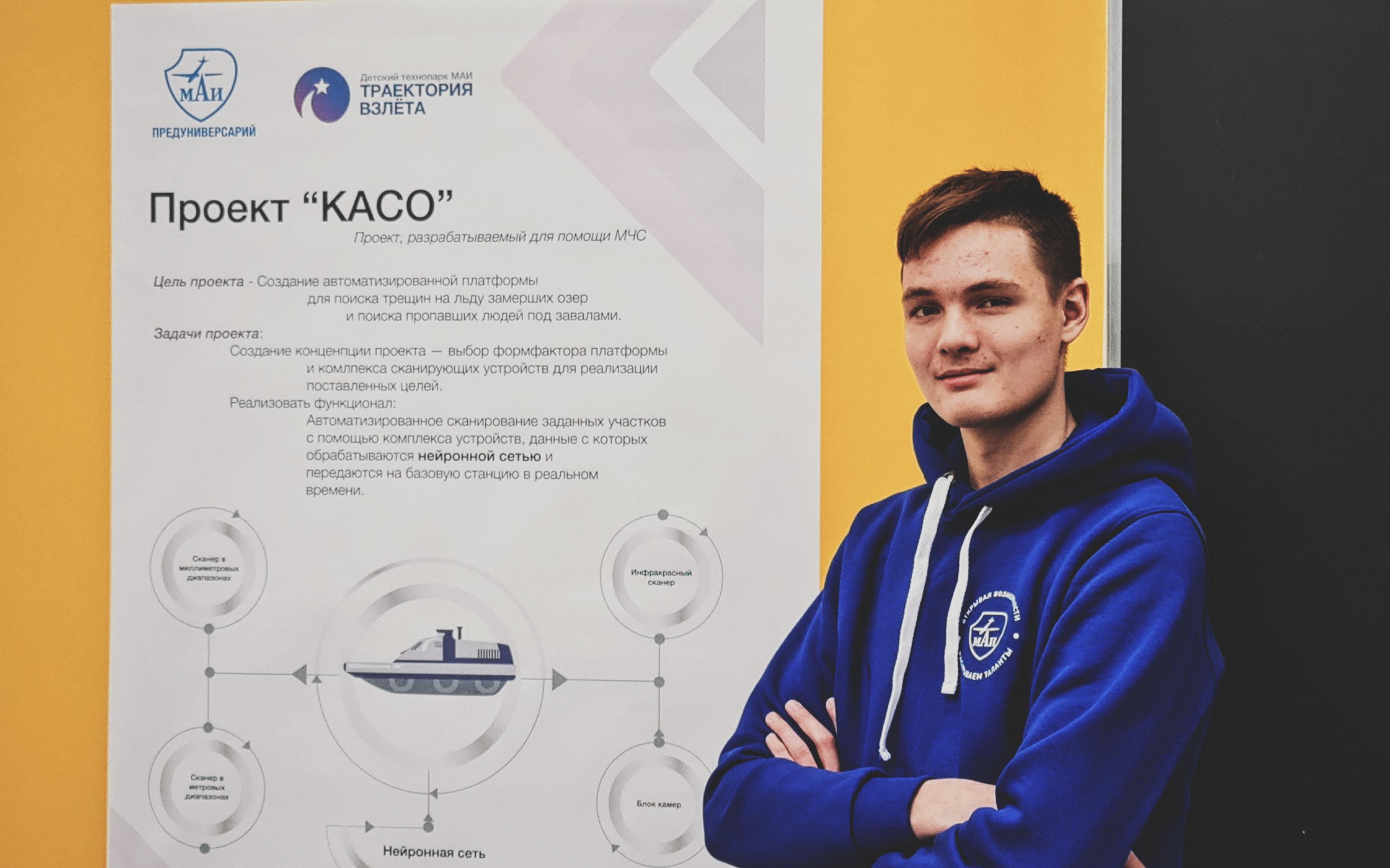 Photo: MAI Press Office / Archive
"See the goal. See no obstacles". That is the principle that contributes to the success of any endeavour. Dmitry Yelovsky, an 11th-grader frequenting the MAI Pre-University School, not only follows this principle himself but has also launched a promising project following that moto. The schoolboy is working on a device for emergency services, which will be able to use high-frequency radio waves to search for people trapped under rubble.
Beware of thin ice
Dmitri came up with this project idea, not while watching disaster movies, but while fishing in the winter.
"Accidents caused by stepping on thin ice are highly common when people go fishing during the winter," he explains. "I decided to design a machine that measures the thickness of the ice on the water surface, which could be used by the Ministry of Emergency Situations to create special maps showing where you can and cannot fish. The principle is simple: the machine sends a radio signal to the ice surface, it is reflected at the water's edge and returns. By measuring the time until the signal returns it is possible to determine the ice thickness.
Next, to make the system more accurate and broaden the range of applications, Dimitri decided to equip it with multi-frequency transmitters. Working at a high frequency, around 2.4 GHz, the system would be able to detect human heartbeats under metal, concrete and other structures, as well as under a layer of snow of around 2 metres thickness.
"This concept of searching for people under the rubble is not unique and has already been implemented in a hand-held device for the Ministry of Emergency Situations. But to find victims with its help, you need an operator who will survey the scene with the device in his hand," says Dmitry. "I propose an autonomous remotely controlled all-terrain vehicle. It may be launched in places where disasters such as an earthquake, an avalanche, hostilities could resume at any moment."
Tracked rescue vehicle
The all-terrain vehicle will be equipped with crawler tracks and will be able to work continuously for up to seven days. It will be powered by solar panels and two internal batteries. According to preliminary estimates, the vehicle will be able to reach speeds of up to 30 km/h. The rover will be controlled via a special interface.
"The operator must select the study area on the map and then the system will build a route itself, like in a navigator, to scan the maximum possible area," says the author of the project. "At any time the operator can contact the rover and receive data from it or switch to real-time control.
In addition to searching for people, the rover can be used for geological and geodesic works, detection of internal cracks and voids in various rocks and materials, etc.
Dmitry has already prepared a 3D model of the hull and defined almost all the "stuffing" of his unit, and now he is designing the running gear and the transmitter. In the future, he plans to complement the rover with an unmanned aerial vehicle with the same functions. Dmitry plans to finish his work as a student at the Moscow Aviation Institute - the young man has decided to enroll in the Department of 702 "Drive Systems for Aerospace Equipment".


